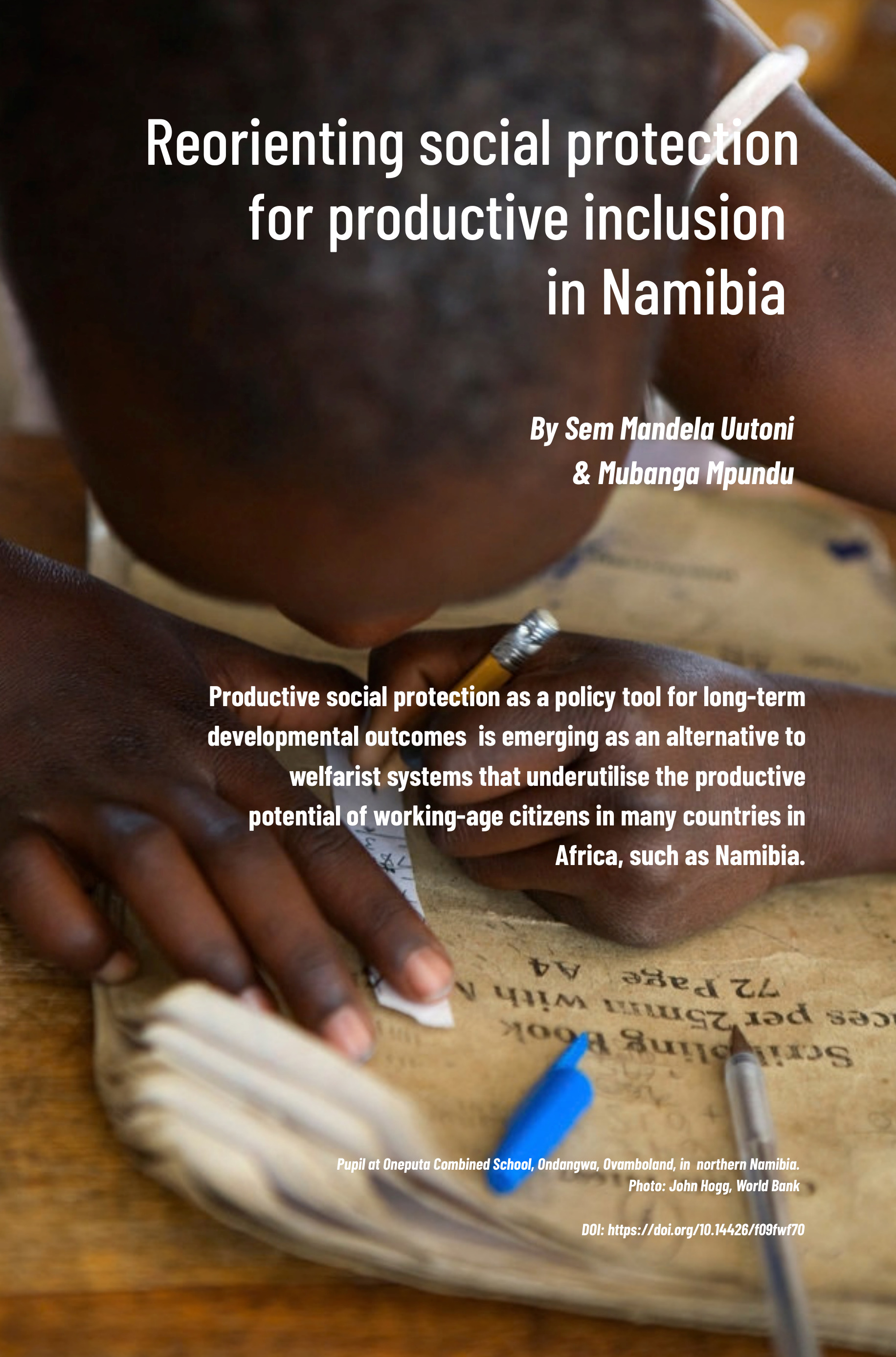
Reorienting social protection for productive inclusion in Namibia
DOI:
https://doi.org/10.14426/f09fwf70Keywords:
Social Protection, Labour Market Integration, Productive Inclusion, Economic DevelopmentAbstract
Social protection has increasingly emerged as a critical policy instrument for addressing poverty, inequality, and vulnerability in developing economies. However, within many African contexts, including Namibia, social protection systems remain predominantly welfare-oriented and insufficiently integrated with labour market and productivity enhancement objectives. This study examines the relationship between social protection, labour market participation, and productive inclusion in Namibia. Adopting an exploratory qualitative research design, the study conducted semi-structured interviews with ten purposively selected policy experts and practitioners, complemented by secondary data analysis. The findings indicate that Namibia’s social protection system underutilises the productive potential of its working-age population because the system lacks institutionalised labour market transition pathways and remains weakly integrated with productive sectors. Additionally, low transfer adequacy constrains beneficiaries’ long-term capacity for productive participation, limiting the system’s ability to act as a bridge to sustainable livelihoods. The study highlights that reorienting social protection toward a structured public-private integration model, enhancing transfer adequacy, and targeting active labour market pathways can better facilitate economic participation and productive inclusion within high-inequality settings.
Downloads
Downloads
Published
Issue
Section
License
Copyright (c) 2026 Sem Mandela Uutoni, Mubanga Mpundu

This work is licensed under a Creative Commons Attribution-NonCommercial-NoDerivatives 4.0 International License.