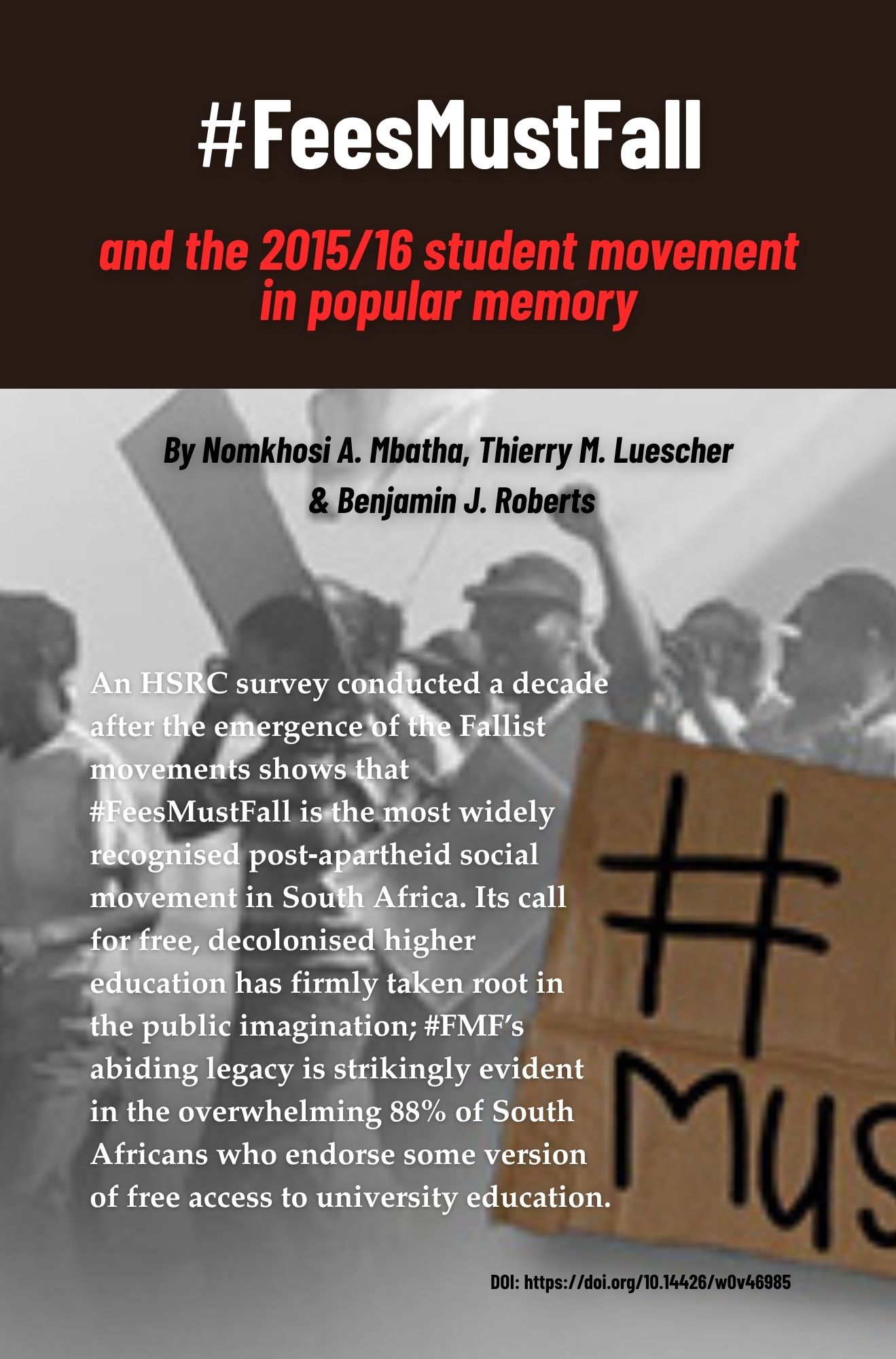
#FeesMustFall and the 2015/16 student movement in popular memory
DOI:
https://doi.org/10.14426/w0v46985Keywords:
#MustFall movements; #FMF;#RMF; higher education; social justice; decolonisation; public attitudes; surveyAbstract
In 2015, the #FeesMustFall (#FMF) and #RhodesMustFall (#RMF) movements challenged the enduring structures of colonialism at South African universities and the legacy of apartheid. Through student-led activism, they advocated for social justice, the removal of colonial and apartheid-era statues, and for free and inclusive education. Students argued that despite two decades of democracy, universities remained sites of inequality, mirroring broader societal tensions and divisions relating to access to higher education, language, epistemology, and cultures of universities. Relevant literature identifies the #MustFall movements as catalysts in advancing a transformation agenda aimed at the ‘Africanisation’ or decolonisation of the South African university, while also confronting structural marginalisation, including class and gender disparities, patriarchy, heteronormativity, and so forth. With 2025 marking the tenth anniversary of the #MustFall movements, this article assesses their legacy by examining public awareness and perceptions using data from the 2025 round of the South African Social Attitudes Survey (SASAS), conducted by the Human Sciences Research Council (HSRC). Findings show that #FMF remains more recognised than any other movement, with 48% of South Africans aware of it, and 77% of this group at least somewhat knowledgeable. This articulates the lasting legacy that even prevails beyond the bounds of the university, driven by the principle of free education, and finds that the movement has been successful in achieving its goals. As a movement born out of student mobilisation and collective action to lay out the grievances of marginalised students, it still represents a living idea of what free decolonised African higher education is in the memories and expectations of South Africans.
Downloads
Downloads
Published
Issue
Section
License
Copyright (c) 2026 Nomkhosi A Mbatha, Thierry Luescher, Benjamin Roberts

This work is licensed under a Creative Commons Attribution-ShareAlike 4.0 International License.