Understanding social ownership in context: Towards a just transition in South Africa
DOI:
https://doi.org/10.14426/dg9pdk64Abstract
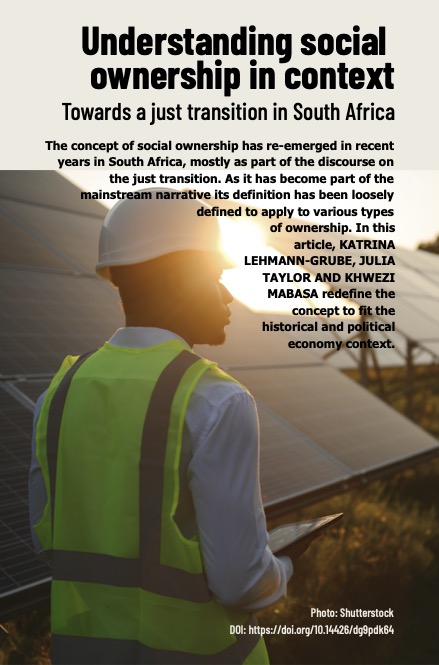
The concept of social ownership has re-emerged in recent years in South Africa within the context of the just transition. The term has been mainstreamed into policy discourse; however, it typically includes a wide range of ownership types, even including private ownership. This risks the dilution of its meaning. This paper aims to define and situate social ownership in its historical and political economy context, both generally, but also in South Africa.
We argue the key characteristics of social ownership include a collective ownership structure, the pursuit of public benefit, democratic control of decision-making and an ethic of cooperation or solidarity. Therefore, worker ownership, cooperatives and public ownership can be considered types of social ownership. Despite the renewed interest, social ownership models are not new in South Africa. There are contemporary and historic examples from which we can draw lessons and experiences. While many of these social ownership models have successes in pursuing public good outcomes, they have also all faced challenges of achieving democratic governance, benefit-sharing and financial sustainability.
The key indicator of a successful social ownership model is its public benefit and social return. While the resurgence of social ownership has been applied almost exclusively to the renewable energy sector, a just transition requires an economy-wide transition which addresses fundamental challenges to South African society, such as inequality, poverty and unemployment.
Downloads
Downloads
Published
Issue
Section
License
Copyright (c) 2026 Katrina Lehmann-Grube, Khwezi Mabasa, Julia Taylor

This work is licensed under a Creative Commons Attribution-ShareAlike 4.0 International License.