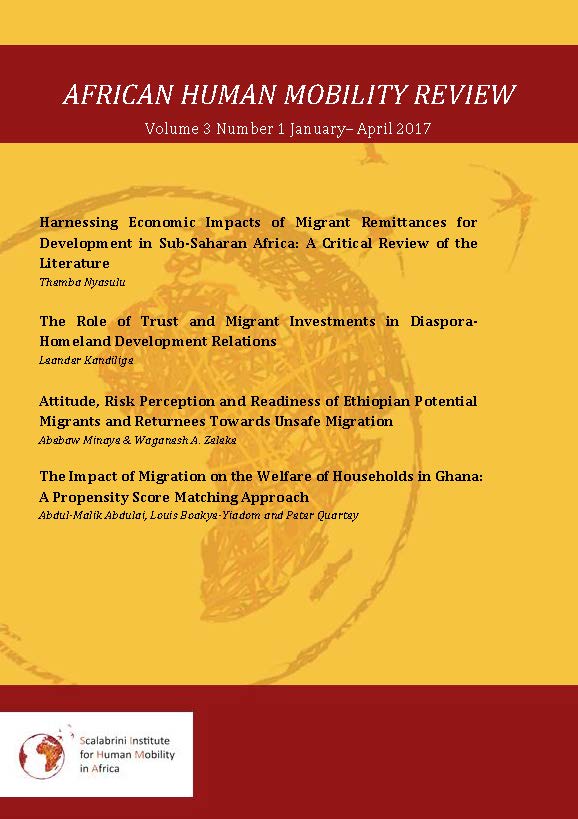
The Impact of Migration on the Welfare of Households in Ghana: A Propensity Score Matching Approach
DOI:
https://doi.org/10.14426/ahmr.v3i1.919Keywords:
Ghana, Migration, Household welfare, WelfareAbstract
Individuals usually migrate to improve their economic conditions and those of their family members left behind. However, less is understood about the impact of internal migration on the well-being of family members left behind. This study contributes to the debate by offering an empirical assessment of the welfare difference between migrant and non-migrant households by analysing data recently collected by the Centre for Migration Studies, University of Ghana. Results from the analysis are inconclusive. Using two indicators of measuring welfare (the World Bank Welfare Index and the number of children enrolled in school at the time of the survey), the latter shows higher welfare in favour of non-migrant households whilst the former indicates equality in welfare for all households. On the other hand, econometric estimations using the Propensity Score Matching (PSM) did not find any significant difference between the welfare of households that sent out migrants and those that did not.
Downloads
Issue
Section
License
Articles and reviews in AHMR reflect the opinions of the contributors. AHMR allows the author/s to retain full copyright in their articles. This is an open access journal which means that all content is freely available without charge to the user or his/her institution. Articles are made available under a Creative Commons license (CC-BY-4.0). Authors who have published under a CC BY 4.0 licence may share and distribute their article on commercial and non-commercial websites and repositories of their choice. Users are allowed to read, download, copy, distribute, print, search, or link to the full texts of the articles, or use them for any other lawful purpose, without asking prior permission from the publisher or the author/s provided the author/s is correctly attributed. This is in accordance with the BOAI definition of open access.
How to Cite