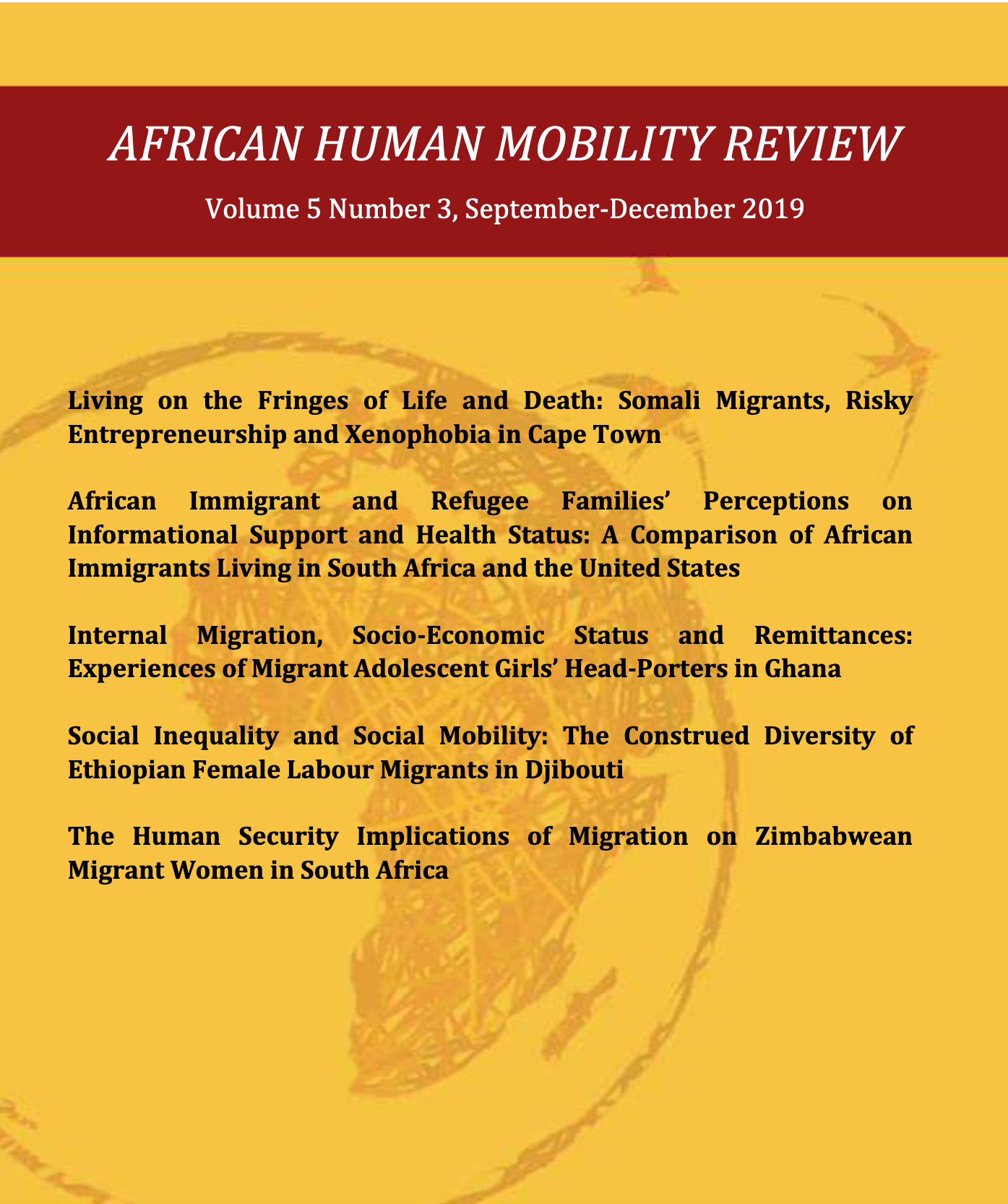
Internal Migration, Socio-Economic Status and Remittances: Experiences of Migrant Adolescent Girl Head Porters in Ghana
DOI:
https://doi.org/10.14426/ahmr.v5i3.889Keywords:
Capabilities-aspirations, Human transport, Kayayoo, Females, Adolescents, GhanaAbstract
This paper examines the relationship between internal migration, socioeconomic status and remittances, drawing on the experiences of migrant
adolescent girl head porters in the cities of Accra and Kumasi in Ghana.
Through an explanatory sequential mixed methods research design involving
503 individual surveys and 24 in-depth interviews, the paper established that
61% of adolescents studied migrated from the north to the south to escape
poverty while 29% migrated to work and raise money for school fees. The
kayayoo business does not seem to capacitate the adolescent girls to live the
kind of lives they have reason to value because only 36% of them remitted to
their families. A logistic regression model showed that older adolescents, 15-
19 years, (AOR=7.32, p<0.05, CI= [1.999-26.802] number of years spent
working as head porter, 3-years, (AOR=3.97, p<0.05, CI= [1.633-9.677] and
socio-economic status – not poor (AOR=8.63, p<0.001, CI=[4.761-8.435])
significantly influenced remittances. Remittances capacitated recipient
families to invest in human capital development and also improved household
food security.
Downloads
Issue
Section
License
Articles and reviews in AHMR reflect the opinions of the contributors. AHMR allows the author/s to retain full copyright in their articles. This is an open access journal which means that all content is freely available without charge to the user or his/her institution. Articles are made available under a Creative Commons license (CC-BY-4.0). Authors who have published under a CC BY 4.0 licence may share and distribute their article on commercial and non-commercial websites and repositories of their choice. Users are allowed to read, download, copy, distribute, print, search, or link to the full texts of the articles, or use them for any other lawful purpose, without asking prior permission from the publisher or the author/s provided the author/s is correctly attributed. This is in accordance with the BOAI definition of open access.