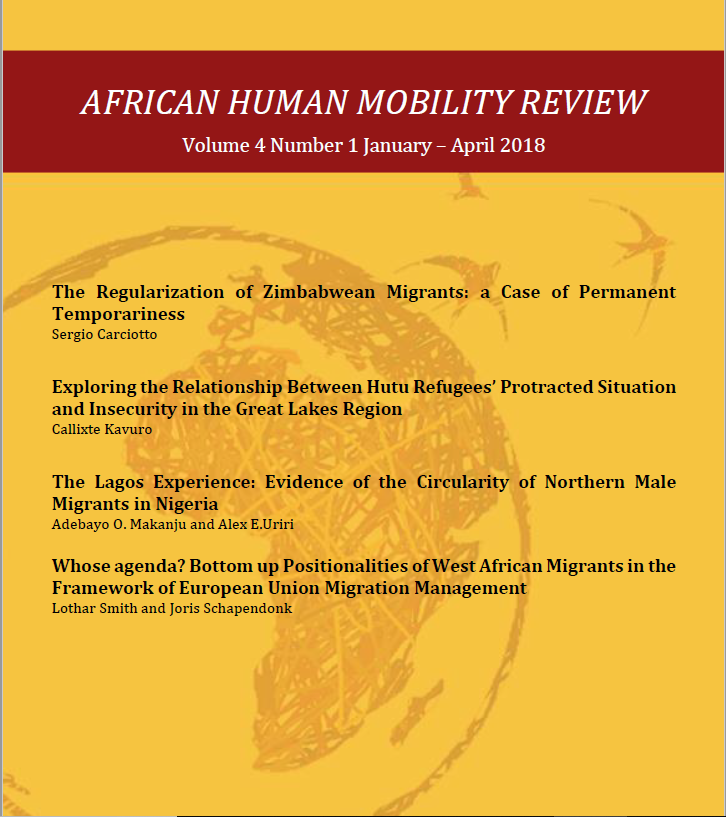
Whose Agenda? Bottom up Positionalities of West African Migrants in the Framework of European Union Migration Management
DOI:
https://doi.org/10.14426/ahmr.v4i1.785Keywords:
Africa, Mobility, Trajectories, Transnationalism, MigrantsAbstract
This paper discusses the position of West African mobility in light of the migration and development debate, and particularly the stance of the European Union (EU) on migration as being caused by failed local development. We hereby follow critical scholars who have highlighted that African migration is still seen as a ‘development problem’. From this starting point, we point to incoherent dimensions of EU migration-development policy-making. Subsequently, we use Sheppard’s notion of positionality to embed the discussion on West African mobility within a wider debate on West African livelihoods as bottom-up processes of globalisation. In so doing, we unbound the question of development beyond the territorial boundaries of a locality. However, these processes lead to new frictions. To further illustrate this, we dive into two empirical cases from Ghana and the Republic of Gambia that enable us to better understand how different positionalities lead to different kinds of values and interpretations regarding the development question. Our suggestion in the conclusion is to maintain such a pluralistic viewpoint on the migration-development relations and to follow more closely the frictions and synergies in these relations
Issue
Section
License
Articles and reviews in AHMR reflect the opinions of the contributors. AHMR allows the author/s to retain full copyright in their articles. This is an open access journal which means that all content is freely available without charge to the user or his/her institution. Articles are made available under a Creative Commons license (CC-BY-4.0). Authors who have published under a CC BY 4.0 licence may share and distribute their article on commercial and non-commercial websites and repositories of their choice. Users are allowed to read, download, copy, distribute, print, search, or link to the full texts of the articles, or use them for any other lawful purpose, without asking prior permission from the publisher or the author/s provided the author/s is correctly attributed. This is in accordance with the BOAI definition of open access.
How to Cite